Join Carlo Salvati Proietti on an expedition through Patagonia's dramatic landscapes — Torres del Paine, Fitz Roy, and Los Glaciares — and discover the images that emerged.
Patagonia is not merely a destination — it is a pilgrimage. For landscape photographers, this remote region straddling the southern tip of Chile and Argentina represents the ultimate proving ground: a place where light, weather, and geology conspire to create scenes of almost unbearable beauty. My expedition through Patagonia yielded some of the most powerful images in my fine art photography collection, and in this article, I want to take you behind the scenes — into the wind, the cold, and the extraordinary moments that made it all worthwhile.
Why Patagonia Calls to Photographers
Patagonia occupies a unique position in the landscape photography world. Unlike more accessible mountain destinations — the Alps, the Rockies, the Dolomites — Patagonia demands commitment. The distances are vast, the weather is violent and unpredictable, and the infrastructure is minimal. But it is precisely this rawness that makes Patagonia so photographically extraordinary.
The region offers an astonishing diversity of landscapes within relatively compact geography: granite spires rising thousands of meters from glacial plains, turquoise lakes fed by ancient ice fields, vast steppe grasslands stretching to the horizon, and some of the most spectacular sunrises and sunsets on the planet. Every direction holds a potential masterpiece.
The Light of the South
What sets Patagonia apart from other great landscape destinations is the quality of its light. At latitudes between 48° and 55° south, the sun traces a long, low arc across the sky, bathing the landscape in warm, golden light for extended periods during sunrise and sunset. This prolonged golden hour — sometimes lasting over an hour — is a photographer's dream. It wraps around granite towers, illuminates glacial ice from within, and paints the steppe in shades of amber and rose.
But Patagonia's light is also volatile. Cloud formations build and dissolve in minutes, creating dramatic chiaroscuro effects that transform a scene entirely. Learning to read Patagonia's sky became one of the most valuable skills I developed during my expedition.
The Journey: Torres del Paine and Beyond
My Patagonian expedition began in Punta Arenas, Chile, from where I drove north through the vast emptiness of the Magallanes region. The first days were spent acclimatizing — adjusting to the wind, which in Patagonia is not a weather condition but a permanent feature of the landscape.
Torres del Paine National Park
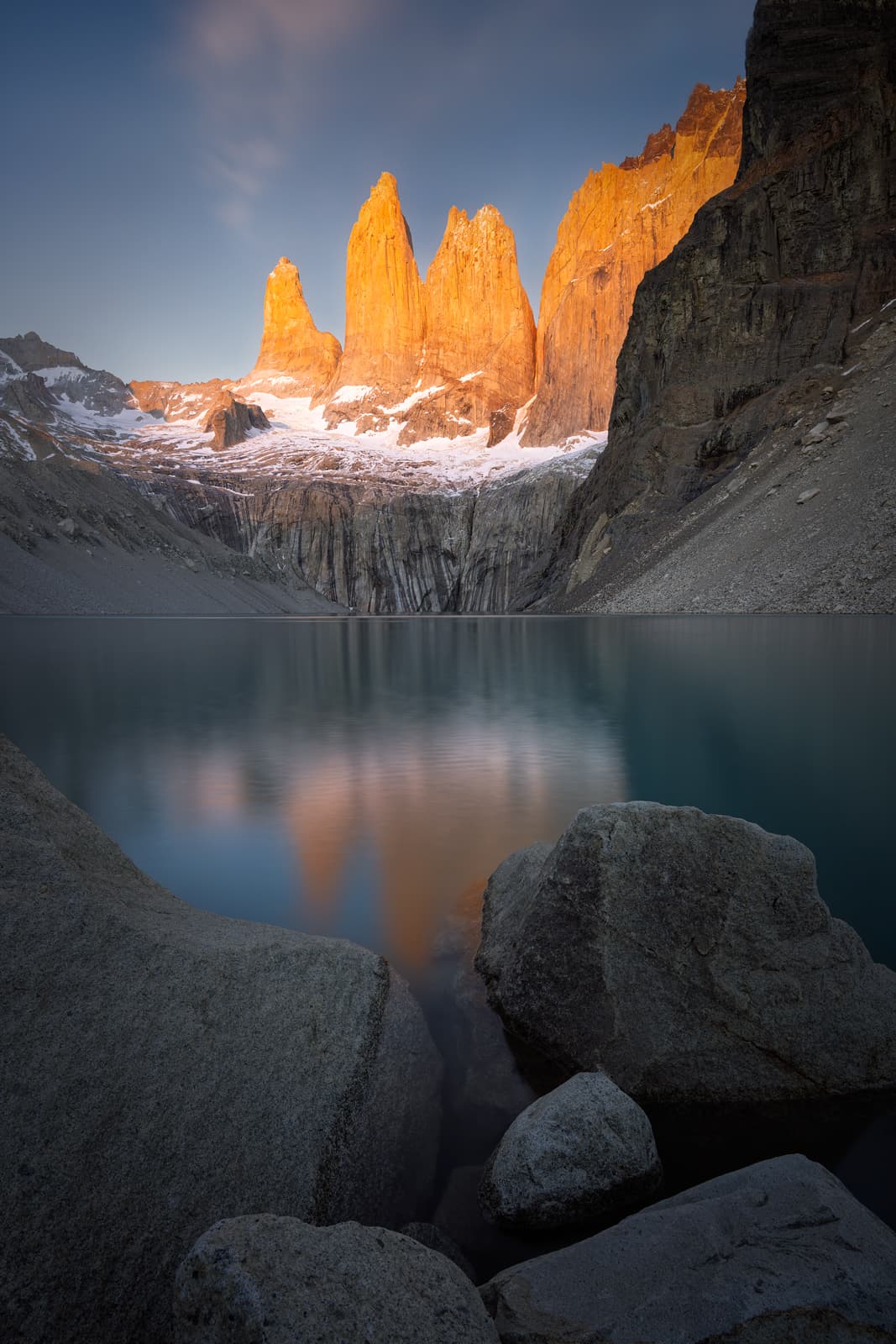
Torres del Paine is the crown jewel of Chilean Patagonia. The park's iconic granite towers — the Torres themselves — rise vertically from the shores of glacial lakes, creating one of the most photographed yet endlessly surprising vistas on Earth. I spent five days in the park, working primarily during the pre-dawn and post-sunset hours when the Torres catch the first and last light of the day.
The conditions were demanding. Temperatures dropped well below freezing before dawn, and the infamous Patagonian wind frequently reached speeds that made it difficult to keep a tripod steady. I developed a technique of weighting my tripod with a suspended rock bag — a simple but essential solution that allowed me to work in gusts exceeding 80 kilometers per hour.
The reward for this perseverance was extraordinary. On my third morning, the Torres ignited in a blaze of crimson and gold as the first rays of sunlight struck the granite faces. The entire scene lasted perhaps four minutes before the light shifted, but in those four minutes I captured several frames that became collector favorites in my portfolio.
The Fitz Roy Massif — El Chaltén, Argentina
From Torres del Paine, I crossed into Argentina and made my way to El Chaltén, a small mountain village that serves as the gateway to the Fitz Roy massif. Fitz Roy is Patagonia's most iconic peak — a jagged granite spire that pierces the sky with almost supernatural drama.
Photographing Fitz Roy requires patience. The mountain is shrouded in cloud for the majority of days, and conditions can change from clear to overcast in minutes. I waited three full days before the clouds parted at dawn, revealing the peak in its full glory against a sky streaked with pink and orange. The resulting image — Fitz Roy bathed in alpenglow, reflected in the still waters of Laguna de los Tres — is one of the most emotionally resonant photographs I have ever made.
Los Glaciares National Park
The final chapter of my expedition took me to Los Glaciares National Park, home to the Perito Moreno Glacier — one of the few advancing glaciers left on Earth. The glacier is a wall of ice roughly 5 kilometers wide and 60 meters tall, and it calves enormous blocks of ice into Lago Argentino with thunderous force.
Photographing the glacier presented unique challenges. The sheer scale makes it difficult to convey in a single frame, and the ice reflects light in complex, ever-shifting ways. I chose to work during the late afternoon, when the low sun painted the ice in shades of electric blue and deep violet, creating images that feel almost otherworldly.
The Creative Process: From Capture to Print
Returning from Patagonia with thousands of raw files, the real work began. My editing process is deliberate and slow — I believe that the finest prints emerge not from the first wave of excitement, but from careful, repeated evaluation over weeks and months.
For the Patagonia collection, I selected just twelve images from over three thousand captures. Each was chosen for its emotional impact, technical excellence, and ability to transport the viewer to the exact moment I experienced in the field. The editing process involved meticulous color grading, precise exposure balancing, and careful attention to the tonal relationships that give each image its atmospheric depth.
The Printing Partnership
Producing museum-quality prints from Patagonia's extreme conditions required close collaboration with my printing partners. The dynamic range of Patagonian light — from deep shadow in glacial crevasses to brilliant highlights on snow-covered peaks — demands printing technology capable of rendering the full spectrum without losing detail at either extreme. I work exclusively with master printmakers who use calibrated, wide-gamut printers and museum-grade substrates to ensure every print faithfully reproduces the atmosphere I experienced in the field.
Each proof undergoes multiple rounds of review under controlled lighting conditions before I approve the final production run. This attention to quality is not optional — it is the difference between a fine art print and a mere photographic reproduction.
Every print in the Patagonia Chile and Patagonia Argentina collections is produced as a strictly limited edition on museum-grade materials. I personally oversee every production run, approving each print before it is signed, numbered, and prepared for delivery.
What Makes Patagonia Prints Special for Collectors
Patagonia fine art prints carry a particular resonance for collectors for several reasons. First, the remoteness and difficulty of the location means that truly exceptional Patagonia images are rare. Unlike more accessible destinations that produce an abundance of similar photographs, Patagonia rewards only those photographers willing to endure extreme conditions over extended periods.
Second, Patagonia's landscapes possess an almost mythic quality — they evoke feelings of grandeur, solitude, and the sublime that have deep roots in the Romantic landscape tradition. A Patagonia print on your wall is not merely decorative; it is a window into one of the last truly wild places on Earth.
Third, as a limited edition fine art print, each Patagonia piece carries documented provenance, a certificate of authenticity, and guaranteed edition scarcity — all factors that contribute to long-term value appreciation.
Equipment and Technique in Extreme Conditions
Photographing in Patagonia demands equipment that can withstand brutal conditions. Wind speeds regularly exceed 100 km/h, temperatures drop well below freezing, and sudden rain squalls can appear without warning. I rely on weather-sealed camera bodies and lenses, supplemented by rain covers and a set of backup batteries kept warm inside my jacket. Cold temperatures drain lithium-ion batteries rapidly — a fully charged battery that would last an entire day in temperate conditions may fail within two hours in sub-zero Patagonian dawn.
Tripod stability is paramount. In addition to the weighted bag technique I described earlier, I use spiked tripod feet that anchor into the rocky Patagonian terrain. For the most extreme wind conditions, I sometimes resort to shooting from a prone position, using my body as a windbreak to shield the camera from vibration. These are not elegant techniques, but they produce sharp images when standing upright is simply not an option.
Lens selection for Patagonia favors wide-angle zooms for the vast landscapes and medium telephoto lenses for isolating individual peaks and geological formations. I typically carry a 16-35mm and a 70-200mm, supplemented by a 24-70mm for general work. Graduated neutral density filters are essential for balancing the extreme dynamic range of Patagonian sunrises, where the sky may be several stops brighter than the shadowed foreground.
Bring Patagonia Into Your Space
Whether you are drawn to the fiery sunrise over Torres del Paine, the serene reflection of Fitz Roy at dawn, or the electric blue of Perito Moreno's ice wall, there is a Patagonia print that will transform your space.
Explore the full Patagonia Chile collection and Patagonia Argentina collection, browse new releases, or contact me directly for a personal consultation on selecting the perfect piece for your home, office, or hospitality project.
Ready to Explore?
Browse the gallery to discover available limited edition prints.